


EMI Shielding and Electromagnetic Compatibility (EMC) for Cables
23 Feb , 2026
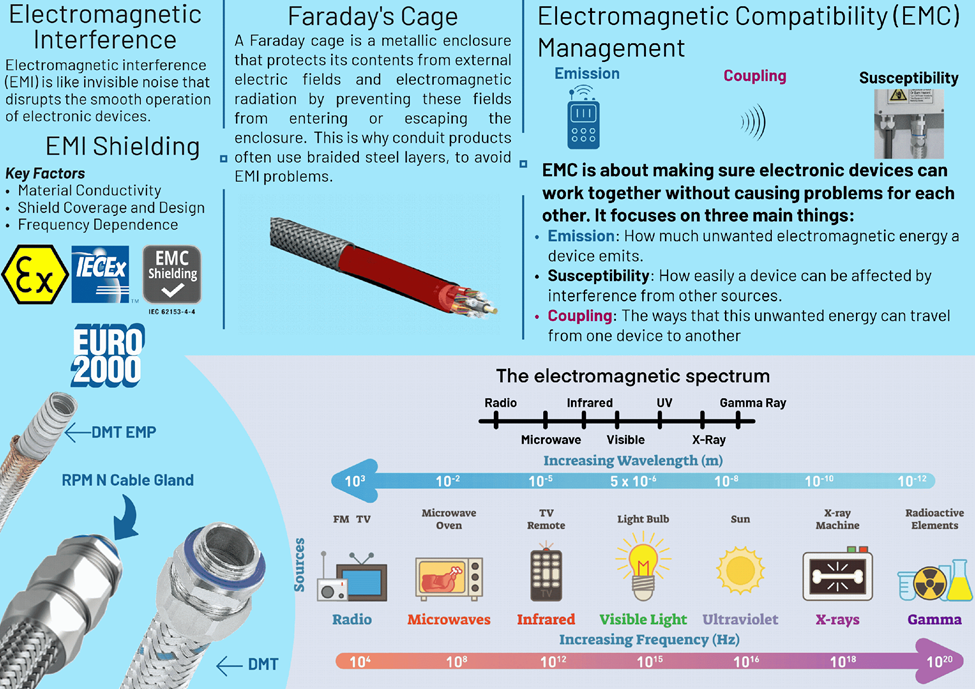
Introduction to Electromagnetic Compatibility, EMI, ESD, and Shielding Techniques
Electromagnetic Compatibility (EMC) ensures that electronic systems function reliably without interfering with each other when operating in the same electromagnetic environment. To achieve EMC, it is essential to control unwanted disturbances such as Electromagnetic Interference (EMI) and Electrostatic Discharge (ESD).
EMI refers to unwanted noise or disturbance in an electrical circuit caused by electromagnetic energy from external sources, which can span audio, radio, microwave, and even visible light frequencies.
EMI can originate from both natural sources (like lightning) and human-made sources (such as motors or electronic devices). ESD, on the other hand, is a sudden flow of electricity between two electrically charged objects, which can damage sensitive electronics.
Techniques like EMI shielding, including Faraday cages are vital for minimizing interference and ensuring EMC in electronic systems.
Types of Electromagnetic Interference
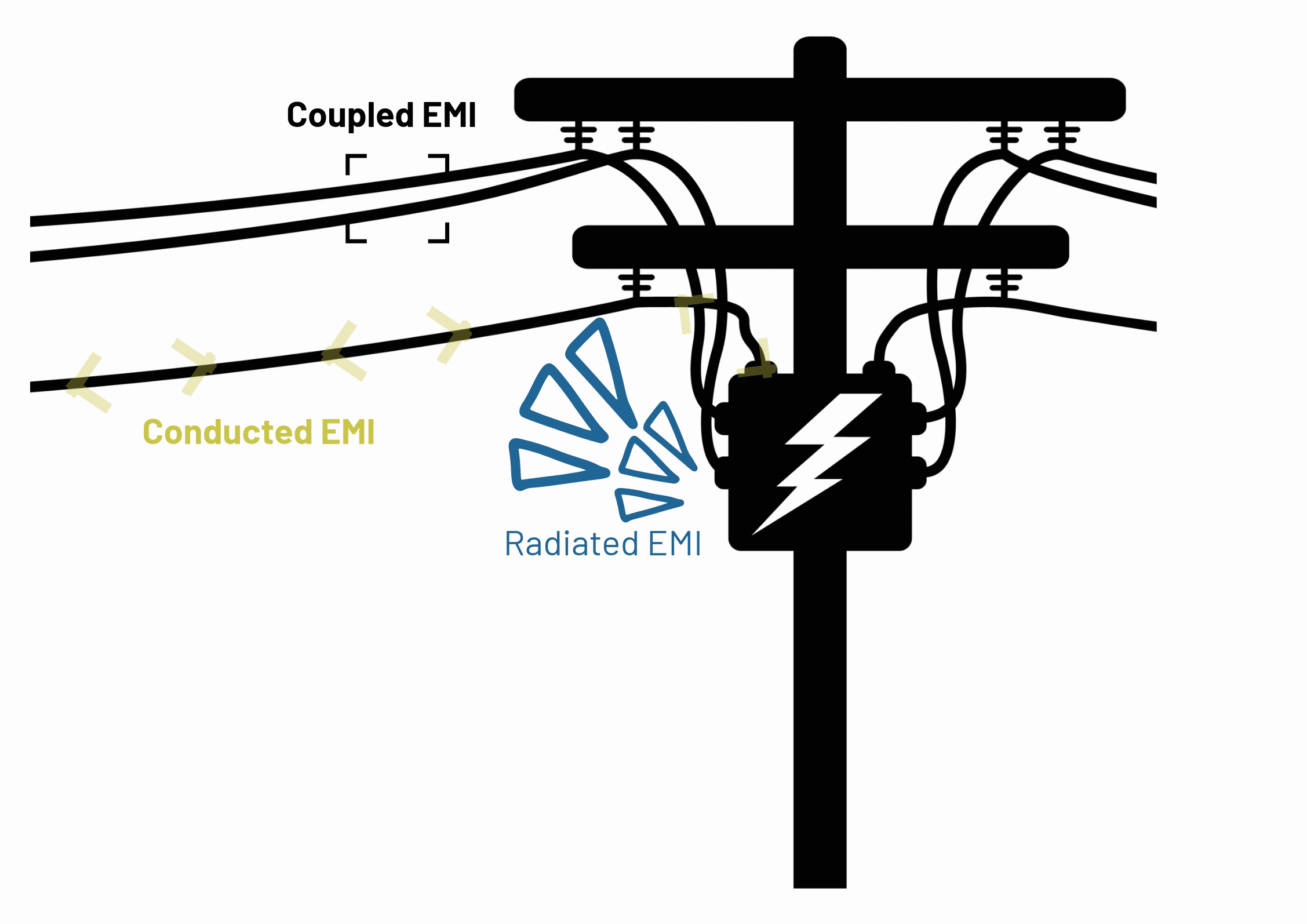
| Types of EMI | Description | Transmission Path | Physical Contact Required |
| Conducted EMI | Occurs when electromagnetic interference travels directly through electrical conductors, creating noise signals that propagate along the cable. | Through electrical conductors (cables for example) | Yes |
| Radiated EMI | Occurs when electromagnetic energy transmits through air without requiring any physical contact; products act as radio antennas and waves propagate through space. | Through air (as electromagnetic waves) (Radio waves mainly) | No |
| Coupled EMI | This happens when the source(device) of disturbance/noise and the affected device are close to each other but not physically connected. In this scenario, the unwanted signals travel through the air or nearby space, not through wires. | The coupling happens via electric or magnetic fields—known as capacitive or inductive coupling, respectively) | No |
Impacts of EMI on Electric Cables
- Common issues: errors, data loss, poor performance.
- Unshielded cables are most vulnerable to unwanted currents and voltage spikes.
- Strong EMI can cause malfunctions or permanent equipment damage.
- Industrial environments require robust shielding due to constant electrical noise.
Electromagnetic Interference Protection: Armoured vs Non‑Armoured Cables
The table compares how armoured and non‑armoured cables handle electromagnetic interference (EMI) in terms of shielding and coupling.
| Feature/Aspect | Armoured Cable | Non-Armoured Cable |
| EMI Protection Mechanism | Metallic armour acts as a conductive barrier, intercepting and reducing EMI before it reaches conductors. | No metallic barrier; minimal EMI protection. |
| Conducted EMI Protection | Armor provides a low-impedance (easy current flow) path to ground, redirecting interference currents (if properly grounded). | No path to ground; conducted EMI can easily affect conductors. |
| Radiated EMI Mitigation | Armor acts as a partial Faraday cage, reflecting and absorbing electromagnetic radiation, especially at higher frequencies. | No shielding; radiated EMI can penetrate easily. |
| Coupled EMI Reduction | Armor reduces capacitive and inductive coupling by providing electromagnetic isolation. | No isolation; higher risk of capacitive and inductive coupling because electromagnetic waves can disrupt the devices. |
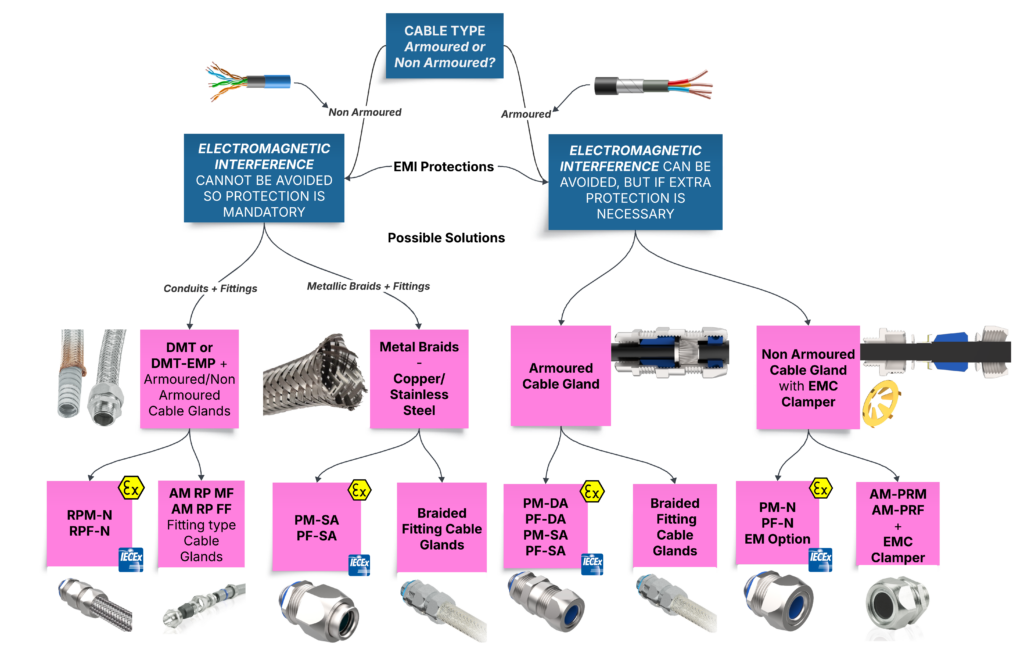
EMI Protection for Armoured and Non‑Armoured Cables with Euro2000 Products
The flow chart shows how to select EMI protection methods depending on whether the cable is armoured or non‑armoured. It outlines possible solutions such as conduits, metallic braids, and different types of cable glands and EMC clamps to ensure adequate shielding against electromagnetic interference for each cable type.
Cable Gland Solutions for EMI
| Product Name(s) | Cable Type | Brief Description |
| RPM-N / RPF-N | Armoured / non-armoured | Fitting cable glands for armoured/non-armoured cables, flexible conduit, ATEX/IECEx. |
| AM RP MF / AM RP FF | Armoured / non-armoured | Fitting cable glands for armoured/non-armoured cables, various thread types. |
| PM-SA / PF-SA | Armoured / Metal braid (Copper/Stainless Steel) | Single tightening cable glands for armoured cables, metallic braids secure sealing, 360° EMC protection. |
| Braided Fitting Cable Glands | Metal braid (Copper/Stainless Steel) / Armoured cable | Glands for metallic braids and armoured cables, ensures 360° EMC contact. |
| PM-DA / PF-DA | Armoured | Double tightening cable glands for armoured cables, enhanced sealing, 360° EMC. |
| PM-N / PF-N | Armoured / non-armoured | Simple tightening cable glands for armoured/non-armoured cables, ATEX/IECEx. |
| AM-PRM / AM-PRF | Armoured / non-armoured | Cable glands with 360° EMC clamper for armoured/non-armoured cables, extra EMI protection. |
All products are typically made of nickel-plated brass and are designed for use in hazardous environments, featuring high ingress protection (IP66/68) and compliance with ATEX/IECEx standards.
EMC Screening Braid Protection
A copper braid covers 90% of the cable, blocking electromagnetic interference (EMI) very well. This braid protects the cable from unwanted signals while keeping it flexible. How metal braid reduces the various EMI types are as follows:
- The copper braid easily carries away unwanted electrical signals to the ground, stopping them from interfering with the system.
- With 90% coverage, the braid acts as a strong shield against electromagnetic waves, even at high frequencies, while letting the cable bend easily.
- The tight weave of the braid leaves very few gaps, stopping interference from getting through by both electrical and magnetic means.
How the Cable Glands Enhances EMI Protection When Used with Metal Braids
When you combine the fitting type cable gland with cables shielded by the EMC screening braid, you create a continuous, highly effective EMI barrier from the cable’s entry point into the enclosure all the way to the equipment inside. The Fitting Cable Gland for Metal Braid is an example of this and here is why this combination is effective:
Maintains Electrical Continuity: The cable gland ensures a secure, conductive connection between the braid and the enclosure, preserving the shielding’s effectiveness by preventing gaps where EMI could leak in or out.
Mechanical Integrity: The gland’s robust design (high resistance to traction and vibration) ensures that the braid remains tightly pressed against the gland body, preventing accidental disconnections or loosening that could compromise EMI protection.
Ingress Protection: The gland’s IP66/IP67/IP68 ratings mean it seals the cable entry against dust and water, preventing environmental factors from degrading the shielding performance.
Broad Frequency Shielding: The combination of a conductive braid and a metallic gland provides broadband protection, blocking both low-frequency (via the mass of the metal) and high-frequency (via the mesh structure) interference.
Combination of RPM-N Cable Gland System with Metallic Flexible Conduits for Ex Applications
The RPM-N fitting system is specifically engineered for non-armoured cables, providing EMC functionality where cable shields ensure contact around the EMC clamper to maintain electromagnetic disturbance within acceptable limits. The nickel-plated brass construction provides excellent corrosion resistance and electrical conductivity, ensuring reliable electromagnetic shielding performance across the operating temperature range of -35°C to +85°C. The system accommodates various cable shielding types including metal braiding, metal wire, and metal tape configurations. This IECEx and ATEX certified system offers comprehensive protection for hazardous area applications while delivering superior EMI control.
The cable glands along with some of our metallic conduits can exhibit high shielding against electromagnetic interferences. Some of our products along with their properties are mentioned in the table below.
| Product Name | Construction & Shielding Features | Effectiveness vs. Radiated EMI | Effectiveness vs. Coupled EMI (Capacitive/Inductive) | Effectiveness vs. Conducted EMI |
| DMT EMP and DMC EMP 50–60 dB (up to 80 dB typical) | Galvanized steel core, PVC jacket, overbraided copper wire for DMT EMP and bronze wire for DMC EMP(EMC-specific) | Excellent (Very high attenuation across wide frequency range) | Excellent (Copper braid provides strong shielding against both capacitive and inductive coupling) | Excellent (Continuous metallic path and copper braid enhance grounding and containment) |
| DMT 30–50 dB (typical) | Galvanized steel core, PVC jacket, overbraided galvanized steel wire | Good (Moderate attenuation, especially at lower frequencies) | Good (Steel braid provides some shielding, less effective than copper for high frequencies) | Excellent (Steel core maintains strong conducted EMI protection) |
| DMT PU 30–50 dB (typical) | Galvanized steel core, polyurethane jacket, overbraided galvanized steel wire | Good (Similar to DMT, moderate radiated EMI attenuation) | Good (Similar to DMT, moderate coupled EMI protection) | Excellent (Steel core ensures strong conducted EMI protection) |
From understanding the fundamentals of electromagnetic interference (EMI) and electromagnetic compatibility (EMC), to exploring advanced shielding solutions, this article has highlighted the critical importance of robust EMI protection in modern electrical systems. Whether it’s the distinction between conducted, radiated, and coupled EMI, or the superior shielding offered by armoured cables, metallic braids, and specialized cable glands, every layer of protection plays a vital role in ensuring reliable performance and safety. By integrating these comprehensive strategies—from cable design to the use of certified glands and conduits—engineers can confidently safeguard sensitive equipment, maintain system integrity, and achieve true electromagnetic harmony in even the most demanding environments.
Ready to enhance your system’s EMI protection? Visit our website to discover our full range of certified cable glands, shielding solutions, and expert support. Take the next step toward uncompromised reliability and compliance, your equipment deserves the best protection!